 FORT WORDEN HISTORY: Battery Powell firing practice round, 1920
Patrick J. Sullivan
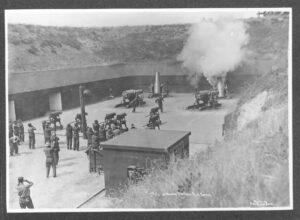
A U.S. Army Coast Artillery Corps soldier tugs the lanyard to fire a 12-inch mortar from Battery Powell at Fort Worden in Port Townsend, WA., circa 1920. Mortars were a key element in the original Harbor Defenses of Puget Sound, intended to direct “plunging fire” at the lightly armored decks of enemy warships.
Construction of Battery Powell took place from 1899-1901. It was the first of Fort Worden’s two mortar batteries to be “proof” fired; but the test on July 11, 1903 resulted in the destruction of the carriage on Mortar No. 3.
During construction of Harbor Defense of Puget Sound mortar batteries, the size varied. Lessons were learned, and Fort Worden’s mortar batteries were generally larger than those at Fort Casey and Fort Flagler. Fort Worden had two mortar batteries with two pits apiece, 16 total mortars.
Pictured here, crews fire a 12-inch mortar from Battery Powell, Pit A. Mortars could be fired electronically or by the pull of a lanyard. These were 1890 mortars on 1896 carriages.
The photo identifies troops from the 5th Co., which was assigned to Fort Worden on July 13, 1916. Two other factors help identify this photo as probably being from 1920. The two forward mortars in this pit were removed in 1920, helping to date this photo (showing all four mortars). Also, P.M. Richardson, the photographer, opened his Port Townsend studio in 1920.
The Puget Sound Coast Artillery Museum also identifies this scene as being “full service” mortar practice. Coast Artillery projectiles could be full service (regulation size and weight) fused as armor piercing or full service cast iron practice projectiles. Practice projectiles would be filled with sand, instead of explosive, to achieve service weight.
Full service practice usually occurred once a year; only so many full service rounds could be fired before the cannon barrel or mortar tube would need to be dismounted and returned to the armory for re-rifling, hence the more common use of practice projectiles.
Mortars were the primary weapon of coast defense. Circa 1900, firing steel-capped projectiles intended to pierce a warship’s more lightly-armored deck before the shell exploded. The mortars fired at an elevation of 45 degrees. The 12-inch mortar filed an 800-pound projectile, propelled by powder charge of 55 to 95 pounds, seven miles. More powder, more range. Less powder, a shorter range.
In 1913, during a Fort Worden visit by Secretary of War Lindley M. Garrison, a first-salvo mortar hit was scored on a moving target raft in Discovery Bay, seven miles west.
While Fort Worden’s cannons pointed toward the water, the two mortar batteries were the only means of protecting the fort’s rear and western flank – a defensive shortcoming that by the mid-1930s led to plans for installation of railway cannons near Cape George along Discovery Bay, west of Fort Worden. While some ground work was done at Middle Point based on the 1920s’ plans, no ordnance was installed because of budget shortfalls.